We all know the song to childhood song.
It sounds sweet. Simple. Almost goofy. The kind of lullaby most of us learned before we had any real understanding of what it means to move through life with DIRECTION, GRIT, & PURPOSE.
But lately, I have been thinking about that little childhood lullaby quite differently.
Because rowing is 1 thing. Knowing where you are rowing is another thing entirely.
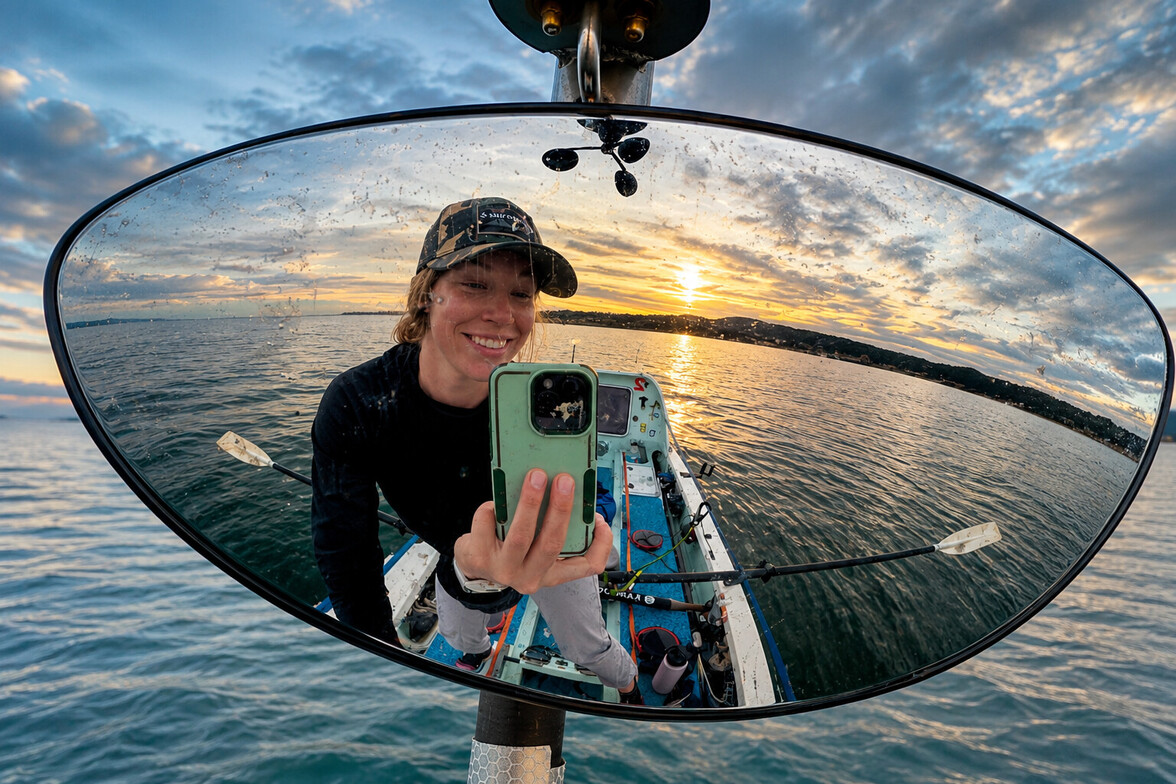
That thought became even more powerful to me as I followed Kelsey Pfendler’s trans-Pacific journey from day 1. Kelsey, a former Grand Canyon river guide, recently rowed solo across the Pacific Ocean from Monterey, California, my old stomping grounds, the place where I grew up, all the way to Honolulu, Hawaii. More than 2,400 miles of OPEN ocean. Alone. In a small ocean rowing boat, affectionately named "Lily."
She completed the crossing in 43 days, 17 hours, 55 minutes, and 59 seconds.
Let that sink in for a moment. Forty-three days. Seventeen hours. Fifty-five minutes. Fifty-nine seconds.
That is not a casual adventure.
That is not a cute little bucket-list check off item.
That is not something someone does because she woke up one morning and felt inspired.
That is a full-body, full-mind, full-spirit commitment.
And because I followed her from the beginning, what struck me was not only the finish. It was the entire story. The waiting. The preparation. The uncertainty. The mind-set that contained the belief she could actually accomplish it. The decision-making before the 1st stroke was ever taken.
From what I followed, she had originally hoped to leave about two weeks earlier, but she was encouraged to hover in the Monterey Bay area because of weather predictions. That detail matters because most of us do not love waiting. We like to get going. We like checking the 'done' box. We like telling ourselves, “I made the decision, so now I just need to go.”
But wisdom often looks like waiting long enough to make an informed decision.
That is not weakness. That is maturity. That is strategy. That is what happens when a person is humble enough to receive consulting, gather data, and respect conditions that are bigger than their own enthusiasm.That delay may have saved her life.
Sometimes courage means going. And sometimes courage means waiting until the conditions are right enough to begin.
Kelsey did not simply throw her boat into the Pacific and hope for the best. She trained. She prepared. She listened. She paid attention. She considered the weather. She had people around her who understood things she needed to know. She accepted consutation and heeded the warnings before launching Lily.
That matters because in life, business, relationships, healing, and mental health, there are moments when we need more than motivation. We need guidance. We need perspective shift. We need someone who can help us see what we cannot see from inside our own emotions. A coach, therapist, mentor, guide, supervisor, trusted advisor, or wise friend can sometimes help us make the difference between bold action and reckless action.
Bold action is informed. Reckless action is impulsive.
Bold action respects the conditions. Reckless action ignores the warning signs.
And once Kelsey launched, the work became beautifully simple & brutally HARD.
She had to row. She had to show up. No matter how she felt. No matter how she feared. No matter how she slept.
When her hands were blistered & bleeding, she had to row. When she was dog-tired, she had to row. When the winds shifted, she had to row. When the squalls came, she had to row. When her body was screaming, she had to row. When her mind likely questioned whether she had anything left, she had to row.
And let’s be honest: there were so many things that could have gone wrong. Not the least of which was capsizing. Being bumped by a whale or shark. A squall so powerful it could fill her boat with water and destroy her instrumentation. Equipment failure. Injury. Isolation. The vulnerability of being alone on the open ocean. The fear of another boat creating danger. I often wondered out loud "What does she do at night; it scary not seeing the horizon anymore and just bobbing up and down in a gigantic body of water?" If she screamed - no one would have heard.
A person does not attempt something like this because she failed to consider the risks. That is not how courage works.
Courage is not pretending nothing can go wrong. Courage is looking directly at what could go wrong, preparing as wisely as possible, controlling what is controllable, and then refusing to remain and dwell inside the fear of all the things that could potentially go wrong.
That is the part we sometimes misunderstand when we see someone do something extraordinary. We assume they must not feel fear the way we do. We assume they must have some special kind of confidence that makes uncertainty disappear.
I doubt it.
More likely, they have learned where to put the fear.
They consider it. They prepare for it. They respect it. But they do not build a home there and hang out there too long.
At some point, Kelsey had to park those fears somewhere in her brain and keep moving toward her her Hawaiian destination. She could not spend every hour rehearsing disaster. She could not give every frightening possibility the steering wheel. She had to control the controllable and keep rowing.
That is a powerful mental health lesson because anxiety loves to rehearse disaster. It loves to ask, “What if?” over and over again. What if this goes wrong? What if I fail? What if I embarrass myself? What if I cannot handle it?
Some of those questions may be worth answering. Preparation matters. Planning matters. Wise counsel matters. But there comes a point when preparation turns into looping thoughts. And looping thoughts are not wisdom. It is fear walking in circles. And, what the brain repeats, it begins to embody
Kelsey also had to row through her emotions. She did not get to run from them. She did not get to numb them. She did not get to escape into a thousand distractions. Out there on the Pacific, there was no alcohol. No drugs. No busy schedule to hide under. No crowd to disappear into. No place to run.
She had herself.
She yelled. She cried. She was scared. She had fearful thoughts. Yet, she rowed.
She had set her course and continued rowing due to real strength.
Real strength is not the absence of fear. Real strength is being afraid and still showing up. Real strength is crying and still telling the truth. Real strength is feeling the wave of emotion rise inside of you and not immediately reaching for something to avoid it, control it our outrun it.
Kelsey had to reckon with herself on that enormous body of water...alone. When there is nowhere to run, you meet parts of yourself that ordinary life lets you avoid. You meet the fear. You meet the doubt. You meet the loneliness. You meet the thoughts that show up when the world gets quiet and the distractions disappear.
And then you have to decide what kind of relationship you are going to have with yourself.
Will you abandon yourself? Will you shame yourself? Will you panic because the feelings are uncomfortable? Or will you sit with yourself long enough to discover that emotions, even hard ones, are not always signals that something is wrong?
At K-Counseling, we talk often about the importance of learning how to sit with discomfort instead of immediately running from it. Eventually, it passes. Our K-Counseling blog library offers support for those who want to better understand anxiety, emotional regulation, stress, & mindset.
Because sometimes the most powerful thing you can do is not escape the feeling. Sometimes the most powerful thing you can do is stay with it; it passes - often after about 90 seconds.
Stay with it. Stay true to yourself. Stay firm with your feet on the ground. Feel the fear. Tell the truth. Take the next right action.
Then row.
And, that is where the little lullaby gets more intriguing.
Row, row, row your boat…
Okay. But where?
Where is all that effort taking you?
Because a lot of people are rowing hard. They are showing up every day. They are consistently 'rowing.' They are working, parenting, paying bills, answering messages, caring for others, carrying emotional loads, & doing what needs to be done.
They are rowing. And rowing. And rowing. Ad nauseam.
But here is the painful truth: you can row consistently and still be pointed in the wrong direction.
You can be disciplined & still be pointed in the wrong direction.
You can be responsible & still be abandoning yourself.
You can be successful & still be deeply disconnected from your values.
You can spend years doing all the “right” things and still wake up one day realizing you have landed somewhere you never wanted to be.
Few things are more disappointing than recognizing you gave your best energy, your best years, your best effort, and your deepest loyalty to a destination that was never truly yours.
This is why direction matters.
A boat does not arrive in Hawaii simply because the rower is sincere. It arrives because the rower keeps correcting course. It arrives because direction is checked over and over again. It arrives because the goal is clear and the actions align with that goal.
Life requires the same kind of honesty. We have to ask ourselves: Where is this taking me?
This relationship. This job. This habit. This pattern. This way of thinking. This avoidance. This people-pleasing. This constant anxiety. This need to control everything. This refusal to rest. This belief that everyone else’s needs matter more than my own.
Where is this taking me?
Anxiety is not always a reliable compass. Sometimes anxiety points toward safety when it confuses noise with signal. Sometimes anxiety points toward control when the real need is trust. Sometimes anxiety points toward avoidance when the real healing begins with facing what we have been running from.
That is why mental health work matters. It gives us the opportunity to slow down, understand our patterns, challenge fear-based thinking, and make choices from a clearer place. You can explore more practical tools and education in our mental health blog library.
Because make no mistake: something is steering your boat, friend.
If it is not your values, it may be your fear. If it is not your purpose, it may be your past. If it is not your clarity, it may be your anxiety. If it is not your wisdom, it may be your wounds.
So here is the challenge.
What are you rowing toward consistently?
Peace? Freedom? Connection? Money? Independence? Healing? Health? Faith? Purpose? A calmer mind? Sobriety?
Or are you rowing toward approval, exhaustion, perfectionism, image management, resentment, & survival?
There is no shame in realizing you need to change direction. A wrong direction does not become right just because you have invested years into it.
That is not failure. That is awareness. And awareness gives you options.
You can pause. You can reassess. You can ask for help. You can get coaching. You can gather better information. You can make a different choice. You can turn the boat.
For more support around anxiety, mindset, stress, emotional wellness, and learning how to move through life with more clarity, visit the K-Counseling blog. Sometimes the first step is not rowing harder. Sometimes the first step is finally asking where all that rowing is taking you.
Because you are capable of more than you think.
But your direction matters.
Row, row, row your boat, friend.
Just make sure you are pointed toward your intended destination.
Lisa Schiro
Contact Me